
July 08, 2026
Editing the late Russ Stewart: Pain, joy, irritation, and frustration
by CYRYL JAKUBOWSKI
He was hated. He was beloved. But he told it like it is, writing prose with caustic wit, perpetually quoting baseball catcher Yogi Berra's implication that "It ain't over 'til it's over" for Nadig Newspapers since bell-bottoms and platform shoes were in fashion.
Back then, gas-guzzling cars had trouble getting gas, President Richard Nixon was in power, it was the "Flower Power" generation, everyone in politics wore suits in a sepia-colored world, and it all seemed like the soundtrack was by Led Zeppelin.
Some city and state politicians feared him, some loathed him, read him, and, still talked to him. For almost five decades.
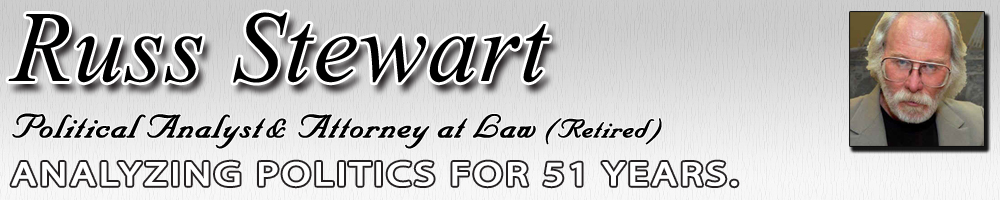
That sardonic local political gadfly Russ Stewart is gone. Dead at 76.
Attorney at law. Columnist. Rabble-rouser. Some would even call him a name that rhymes with "brick."
"It is said that absence makes the heart grow fonder. It is also said that out of sight is out of mind. I have been writing this column weekly for Nadig Newspapers for almost 53 years, starting in mid-1973. By my count, at 50 columns per year and 1,550 words per column, that amounts to 2,650 columns and 4,100,000 words. That is more than enough productivity for a part-time political analyst," he wrote in his farewell column in November of last year.
When I first began working at Nadig Newspapers as a cub reporter in 2008, Stewart was a mythical figure that would sometimes show up in the newspaper office on Milwaukee Avenue in his red Corvette, walk into the editor's office wearing all black or a trench coat, or a full light gray suit and tie, shut the door, and angrily discuss the week's column with the editor.
The former editor, who was cranky at times, was made even crankier because of Russ, but somehow they made it work for decades. I've never witnessed any shouting matches between the two since I was busy reporting, but I would get a sense that things were not up to snuff during lunchtime.
"Mr. Stewart is on line 100," the secretary said.
And you would hear the editor pickup the cream-colored phone in his office.
"Newsroom."
And after a few minutes they would, quietly, over the phone, call each other the most colorful language, the most abstract mixture of swear words and adjectives known to man, like parents talking to a child in a toy store in a hushed tone, threatening violence when they return home.
"Yeah, f*** you too," the editor would whisper, and hang up, and the column would be published, edited, not to Russ' liking.
Russ wrote about city politics well because he had connections. He had seen regular people become lifted into the echelons of City Hall power, get crumbled or corrupted by it, and then live to tell the tale, or spend time in the slammer.
He was an excellent numbers cruncher, pulling up stats from here and there, and a walking database of city history, as well as a political prognosticator.
But like every ball player, eventually his numbers would slip, and he would start riding the bench. And it almost became a blessing if Russ said that you would lose a political race, as the opposite was usually true. He famously incorrectly predicted that Willie Wilson would win the primary in 2023, with Vallas second, Garcia third, Johnson fourth and Lightfoot fifth. People on social media lost their minds with glee when he was wrong. “How tone deaf,” some would say. “Terminally incorrect prognosticator Russ Stewart,” others would say.
"I have made a plethora of predictions on federal, state, county and local outcomes, probably slightly less than half correct. Hey come on, some people also thought Mike Tyson would knock out Jake Paul," he said in a column once. He gloated when his predictions were right. He stayed silent when they weren't.
By the time I became editor, I've already known Russ for years. I've been to his house and faced his dogs at the rear entrance to pick up the column "because the server was not working."
He had so many dogs that when you got there you were at his mercy, because those collies or hounds were excited. I clocked six or seven dogs there at one time. And for the record, he loved all of those dogs. He really did.
Past the barking dogs, you would have to pick up the written manuscript in those years, one that you would have to retype. Eventually Russ heard about flash drives and e-mail.
And his house? Listen, if recreational cocaine was a house — metaphorically speaking — it would be just as you would imagine an 80s "Miami Vice" house, with Vegas decor, giant house plants, lots of mirrors leading up carpeted stairs to his office that was filled with newspapers, an old desktop computer, and a modem connected to the "Internet."
"Just doing my Googling here, Cyryl, I will have the column in 25 minutes," he would say, in a deep baritone voice.
But as "beloved," as he was, and as much as he gave it to the powers that be, he was also despised by many.
Some people absolutely hated his guts. He would often come up with unflattering nicknames for politicians, and naturally, they hated him. He would leave uncouth messages on people’s answering machines. And they would call the office to complain. “What’s wrong with him?”
I won't name names, but "f*** that walrus," one former state representative told me, because of his long mustache. Others just threw out expletives ad nauseam or become apoplectic upon hearing his name. "You actually know him? You should be ashamed of yourself." Some aldermen back in the heyday hated his guts so much they threatened violence. This is probably why he lifted weights.
His political philosophy was based on the idea that ethnic last names won elections in Chicago. Irish surnames like O'Brien, Kelly, Daley, Doherty, Cullerton, O'Connor and others won in the White wards because of their names and not their platforms or who they were, and "Black sounding names" won in the African-American communities, and Hispanic names won in the Latino wards. This was his "machine" politics view of the world.
It was a simplistic and outdated approach, but was he wrong? Was he right? He talked about "once a ward becomes White or Black it stays Black or White, or Hispanic." He talked about "parking of campaign funds" which Michael Madigan was known for. How politicians move money around. Who gets what? How committeemen were conduits to patronage. About double-dipping. Getting two pensions. Staying on long enough to get one. CFD, CPD, CPS, City Hall ... Russ didn't care. He knew people were gaming the system. He called it the "theft of taxpayer money you can't even see."
He tried to sound the bullhorn about corruption, but nobody wanted to listen. Union influence. Precinct voting. But to the outside world it was just some guy in a local newspaper. Nobody listened, and "they" all got their "plums" as he called it.
But that was an era before progressive politics. Before "Democratic Socialists" as he called it, or "Communists." I would have to limit his use of the word “wokesters” or “lefties,” because at the end there, he became obsessed with “them,” because they “lack common sense,” he would say.
Because he frequently analyzed race as a central metric in voting blocks, demographics, and elections, he was sometimes called racially insensitive by his critics. I think I would be able to tell after editing his column for a decade if he was some kind of a racist. I didn’t get that vibe. I think his folly was that he viewed city politics through ward demographics too much and some felt these only reinforced outdated stereotypes.
He wasn't politically correct. But he somehow knew the city, the breakdown of wards, and how people may possibly vote.
He was a proud Republican, and he knew his columns upset many folks. Perhaps he lost readers when he announced his support for Donald Trump. Then again, he may have gained a few in the conservative belt of the Northwest Side. All I knew was that he was exercising his freedom of speech. I just let him hang himself by his own words.
And like every editor, eventually I would grow tired of his antics too. Except I didn't whisper sweet nothings to him over the phone, gently try to let him off the hook. It was a J. Jonah Jameson-style explosion where we just screamed at each other and raised each other's blood pressure for several minutes.
"You can take this column and shove it up your ass. I'm not printing this!"
"F*** you!” Russ would growl.
"No, f*** you! Spelling errors, wrong names. Are you a professional, goddammit?!”
"I've written more columns than your years on this planet, sport," he would retort.
"Well these ‘years’ are saying you're spelling people's names wrong. Get it right, or it's the last time you'll see your name in print!"
The next week we would pretend nothing happened and argue again about something I've cut or changed the following week.
In his later years, Russ would send e-mails about how he "can't get his head in the zone."
I would get an e-mail saying "Abort. Abort. No column this week."
In his final column, Russ wrote, "Thank you for sticking around. I'll keep you posted. Or you'll read here (that) I croaked."
The "Yogi-ism" was "It ain't over 'til it's over."
This time it's over.
Read more Analysis & Opinion from Russ Stewart at Russstewart.com
This column was published in Nadig Newspapers. If you, a friend or a colleague wish to be added to Russ's BUDDY LIST, and be emailed his column every Wednesday morning, email webmaster Joe at Joe@Nadignewspapers.com